
THE NATURE
REPORT
March
2008
Home page
THE NATURE
REPORT
March
2008
Home page
|
As if to celebrate Saint David’s day (the patron saint of Wales), I found these daffodils in full bloom in the gully. A clear indication spring is on its way. If you read last months report you will know that I have a little competition going between me and Mr Buzzard in that I have to photograph him sitting rather than flying this has been ongoing for some considerable time now as he is a little camera shy. Frustratingly I have been within just a few yards (meters) of him on more than on occasion but I have never had my camera with me.
The dark edge to the photograph on the right is the trunk of the tree that I hid behind when I spotted him. One benefit of this time of year is the lack of foliage on the trees and As I was approaching the Heifer banks, through the hedge I spotted one of Phil’s favorite animals. This “cuddly” rabbit was lazily relaxing behind the hedge in the early morning sun and did not spot my approach.
Because of the predominance of yellow (particularly in the male) in its plumage, many casual observers miss identify it as a Yellow Wagtail. The Grey Wagtail can be distinguished from its yellow cousin by the grey plumage of its back.
In this photograph it is not standing on solid ground, rather it is actually standing on floating plant material in the form of dead leaves and twigs which have floated down the river and become caught up on the bank.
It appeared completely undisturbed by my presence despite my close proximity, and provided me with several minutes’ entertainment as it repeatedly crept up the tree trunk before flying down to start all over again.
They are not amongst the most common birds here at Greenheyes, indeed it was only about 2 ½ years ago since I spotted the first one here. Since then I’ve seen them on several occasions and it would appear that their numbers are growing. As their name would imply they feed on nuts and seeds such as acorns, and insects. At this time, this particular tree was proving very popular for hardly had I been joined by the Nuthatch when a loud drumming sound indicated that a woodpecker had joined us.
This next photograph (right) shows damage inflicted on the bark of a tree by a woodpecker in its search for food.
The right hand photograph is a close-up of part of the bark. You can clearly see teeth marks that have been left behind by the perpetrator. The tooth pattern would indicate that the culprit is a rodent, and my money is on it being a Grey Squirrel.
This Wood Pidgin has selected its tree with a view and is in the process of constructing its dream home. Lets hope it impresses his better half. see you next month Andy |
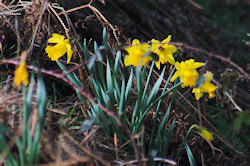 I have to say that March has not been a bad month in terms of the weather. It has been reasonably dry, generally mild with a few frosty mornings thrown in for good measure.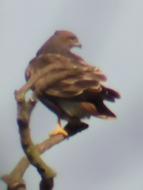
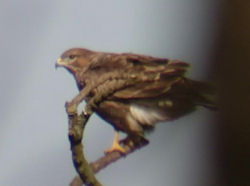 Well guess what this month I finally bagged the fellow sitting (well standing actually). and here's the proof.
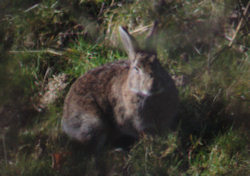 hedgerows. Not only does this allow you to see what is in the tree of the hedge it also enables you to see through them.
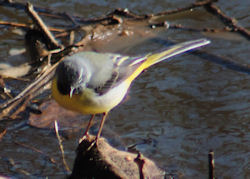 After making my way down to the river Dane, I spotted this Grey Wagtail looking for food at the waters edge.
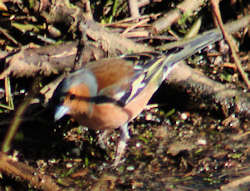 Joining the wagtail in its search for food was this male Chaffinch.
 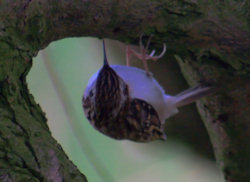 Also looking for food but this time in the bark of a tree rather than at the waters edge was this tree creeper.
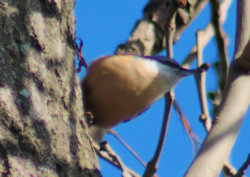 A blur of movement higher up in the tree brought my attention to this Nuthatch.
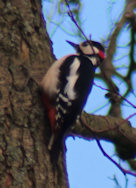 Sure enough on following the sound of the drumming I soon located a Great Spotted Woodpecker (left) searching the back of the tree for insects and grubs.
 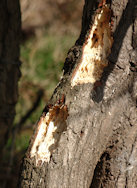 They have become a very common site over the past two years and there are now quite a number here at greenheyes.
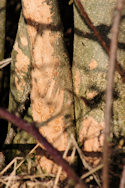 It is not only the woodpeckers that can damage the bark of trees.
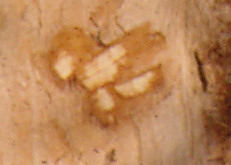 In the photograph on the left you can see where the bark at the base of this young tree has been stripped away.
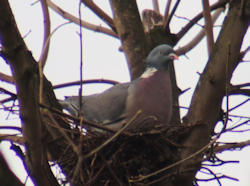 My final photograph this month is of a home builder. Spring is in the air and you have to have a place to take home the girl in your life, settle down and raise a family.