
THE NATURE
REPORT
JUNE 2003
Home page
THE NATURE
REPORT
JUNE 2003
Home page
|
Unlike last June, the rainfall this time came in two short but heavy bursts at the beginning and the end of the month and for the most pat it has been a rather pleasant time.
Here are two that Andrew our webby managed to catch with his camera.
The photo on the right show it and its siblings a couple of days later having moved out of the nest.
Although they are mostly seen with flowers that are a reddish pink in colour, you can , as the image on the right shows, find them with all white flowers. Our friend the Bumble Bee's taste was not restricted to the Foxglove.
A second type of poppy to be found on the farm is the long-headed poppy shown here on the right. It can be distinguished from the common poppy by the elongated shape of its seed pod.
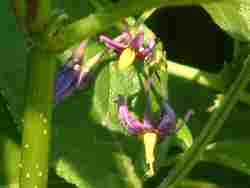
It is not quite as poisonous as its cousin the Deadly Nightshade, but I strongly suggest that you look but don't touch either of them.
Another word of caution here, Although the likes of the common field mushroom are non poisonous and very tasty, many of the fungi you find are in varying degrees poisonous with symptoms ranging from nausea and stomach cramps to death. If you want to go collecting wild fungi to eat start by going out with an expert, that way you will live to enjoy your harvest.
However he replaced the stone and discreetly left them alone. Well that's about it for now, See you next month Phil. Back
to June Journal / Back
to Nature Trail / Previous
Page
|
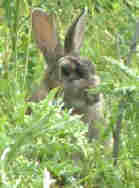
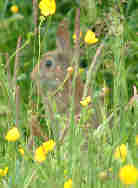 Making
the most of the fine weather our rabbit population has seen a slight
increase in numbers, much to the delight of Smidge our small terrier
dog who loves to try to catch them.
Making
the most of the fine weather our rabbit population has seen a slight
increase in numbers, much to the delight of Smidge our small terrier
dog who loves to try to catch them.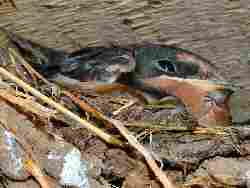
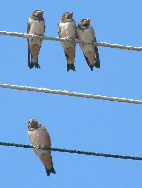 Also
caught on his camera was this fledgling swallow just prior to its leaving
the nest.
Also
caught on his camera was this fledgling swallow just prior to its leaving
the nest.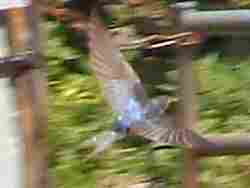 Anxious
to prove that he could also hit a moving target Andrew also captured
this adult swallow as it pulled up to avoid a gate in its flight path
Anxious
to prove that he could also hit a moving target Andrew also captured
this adult swallow as it pulled up to avoid a gate in its flight path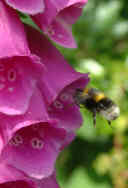 Also
caught in flight was this Bumble Bee, as it came in to land on this
Foxglove.
Also
caught in flight was this Bumble Bee, as it came in to land on this
Foxglove.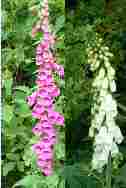
 As
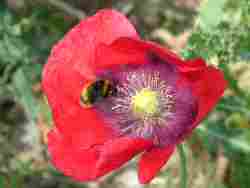
this picture shows the Poppy also holds an attraction for it.
As
this picture shows the Poppy also holds an attraction for it.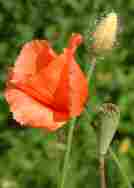
 These
purple and yellow flowers belong to the Woody Nightshade.
These
purple and yellow flowers belong to the Woody Nightshade. 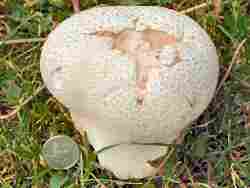 This
large fungi is an immature Puffball. Eventually it will open at the
top to release its spores.
This
large fungi is an immature Puffball. Eventually it will open at the
top to release its spores.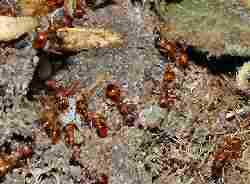
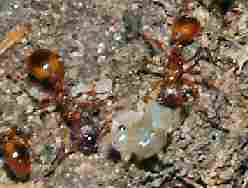 On
a final note for this month, while photographing the Puffball, Andrew
disturbed a small rock, underneath which he discovered a colony of Red
Ants. Ants are highly organism insects and their first priority was
to move the immature pupae (shown right) to safety, while others, if
Andrew had given them the chance, would have expressed their disapproval
of his action.
On
a final note for this month, while photographing the Puffball, Andrew
disturbed a small rock, underneath which he discovered a colony of Red
Ants. Ants are highly organism insects and their first priority was
to move the immature pupae (shown right) to safety, while others, if
Andrew had given them the chance, would have expressed their disapproval
of his action. 