
THE NATURE
REPORT
February
2004
Home page
THE NATURE
REPORT
February
2004
Home page
|
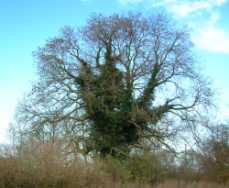
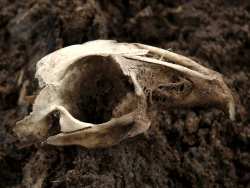
As I was passing under the winter skeleton of the tree shown on the right, I noticed a fresh pile of soil deposited where some rabbits had excavated a fresh burrow. A closer look showed that they had unwittingly excavated the bones of one of there ancestors.
Whether the animal died naturally of old age / disease or was the victim of a predator I can't tell.
Sadly the skull was incomplete, the bone at the rear of the skull was missing.
On a somewhat smaller scale just under the tree were the remains of several owl pellets. These are the indigestible remains of the animals that the owl has had for its meals.
By studying the bones it is possible to determine just what animals the owl has been eating in its diet. Further study of these bones can give indirect evidence of the population and health of the small animals that the owls feed upon.
At the point mentioned in earlier reports where there has been considerable erosion of the bank due to a fallen tree diverting the flow of water, the change in the rate of flow of the water in the middle of the river has resulted in sand, gravel and other objects have been deposited.
I have to confess I am not sure as to what the animal it belonged to is. I suspect that it is either a horse or a cow. I shall have to get Phil's opinion.
Moving away from bones now, you may have read in previous nature reports how I have found several interesting items that have been exposed as the river has washed away the sediments of the bank. At the time that I was taking the photograph of the jawbone, a cursory inspection of the bank showed that other wooden remains had been exposed.
The thin pin on the left of the picture is made of wood, and was probably a means of joining two pieces of wood together. What is it? I have no idea.
This brings me to the last part of my report this month, birds. While near to the tree mentioned at the start of this report I managed to snap a couple of shots of some of our feathered friends.
While these are not uncommon this is the first time I have caught one on camera.
This is the male of the species, the female lacks the bright yellow beak and is of a lighter colour than the male. Finally I had a visit from an inquisitive
"Jenny" wren This is the smallest of the UK's birds. Around Greenheyes they are a reasonably common bird. Apart from their small size they also have distinctive appearance and are easy to recognize.
I had inadvertently taken a picture of a squirrel. Well that is definitely the end for now. Hope that this has been of interest. Webby Back to February Journal / Home page
|
 I
start this month by getting down to the bare bones, literally.
I
start this month by getting down to the bare bones, literally.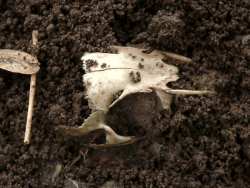
 These
bones proved to be a skull.
These
bones proved to be a skull.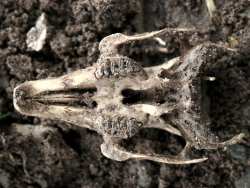 The
underside view give a good look at the dentition (teeth) which appeared
to be in good order.
The
underside view give a good look at the dentition (teeth) which appeared
to be in good order.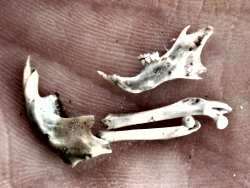 This
photograph shows you just a few of the bones that can be found in a
single pellet.
This
photograph shows you just a few of the bones that can be found in a
single pellet. 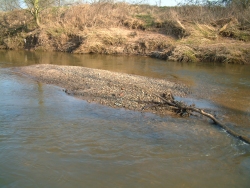 The
final example of bare bones comes from the
The
final example of bare bones comes from the 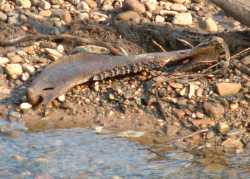 Amongst
this debris, a closer observation revealed this lower jaw bone.
Amongst
this debris, a closer observation revealed this lower jaw bone.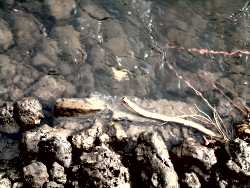 A
careful look at this photograph (left) shows a piece of wood recently
exposed.
A
careful look at this photograph (left) shows a piece of wood recently
exposed. This
photograph on the right shows the wood after it was excavated and cleaned.
This
photograph on the right shows the wood after it was excavated and cleaned.
 While
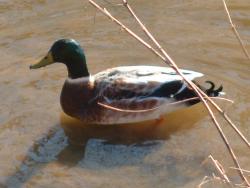
doing my "Time Team" impression this male mallard swam past,
eying me up somewhat suspiciously.
While
doing my "Time Team" impression this male mallard swam past,
eying me up somewhat suspiciously. 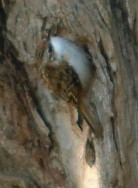 The
first is Tree-creeper, These are a fairly common bird around the trees
of the riverbank here at Greenheyes.
The
first is Tree-creeper, These are a fairly common bird around the trees
of the riverbank here at Greenheyes.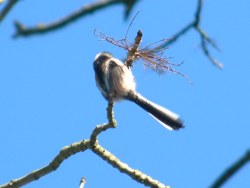 The
next photograph is of a Long Tailed Tit.
The
next photograph is of a Long Tailed Tit.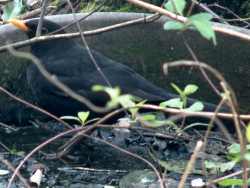 Another
bird that I caught on camera for the first time was this blackbird lurking
in the undergrowth of the hedge.
Another
bird that I caught on camera for the first time was this blackbird lurking
in the undergrowth of the hedge.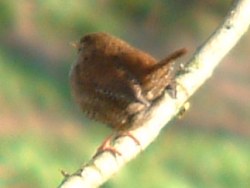
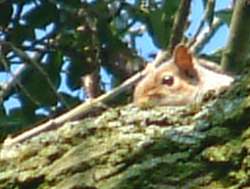 I
said finally, well almost, while I was taking a closer look at one of
the photographs that I had taken (it's surprising what you can find)
I noticed this little eye observing me.
I
said finally, well almost, while I was taking a closer look at one of
the photographs that I had taken (it's surprising what you can find)
I noticed this little eye observing me.