In 1967, this disease ravaged Cheshire
and although I was just 7 1/2 years old, I can vividly remember that
winter.
Here at Greenheyes we did not get the disease but at Dorothy's Father's
they were not so lucky and they lost all their 144 cattle.
The time line for this was as follows. Tom (Dorothy's father) found
on cow seeming to struggle eating its food while he was milking so he
called the vet, the time was around 9.30 am by 12.00 noon he had arrived,
checks revealed what Tom suspected Foot and Mouth.
This and several other suspect animals were shot that day and the following
day the herd was valued and the rest of the herd were also killed. While
this was going on the diggers had arrived and begun to dig a "grave".
By evening on the next day, all the cattle were buried and the disinfecting
process began. After 6 weeks, they began the process of buying replacement
cows.
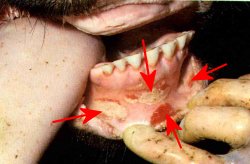
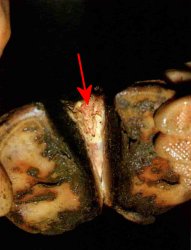 These
pictures show some examples of foot and mouth. The red arrows point
to the ulcerated sores which develop in the mouths and on the feet of
infected animals. It is not uncommon for these lesions to develop secondary
infections.
These
pictures show some examples of foot and mouth. The red arrows point
to the ulcerated sores which develop in the mouths and on the feet of
infected animals. It is not uncommon for these lesions to develop secondary
infections.
Most people are surprised to find out the
Foot and Mouth is rarely fatal. Most susceptible are young animals.
The disease affects the muscle of the heart, resulting in its function
being impaired to such a degree that death occurs.
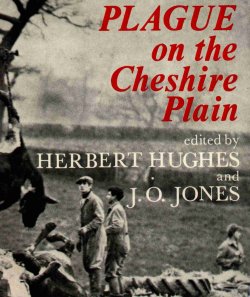 For
anybody interested in learning more about the 1967outbreak in Cheshire,
plus disease history I can recommend "PLAGUE on the Cheshire
Plain" which lists all the affected farms in the order
in which they got the disease together with pictures of the people involved
in the battle against it.
For
anybody interested in learning more about the 1967outbreak in Cheshire,
plus disease history I can recommend "PLAGUE on the Cheshire
Plain" which lists all the affected farms in the order
in which they got the disease together with pictures of the people involved
in the battle against it.
For reference the code on this book is ISBN 234 77330 8
Also not spared in the 67 was Alan (our combine harvester friend) and
his family, he says he remembered his father coming into the house heartbroken
after the confirmation of the disease 96 cattle 64 sheep and 10 pigs
their grim total. They no longer keep any pigs but today they have around
200 sheep and 200 cattle!
I hope this will provide some help for those wishing to understand this
disease
If you would like to know more visit the MAFF web site
at
www.maff.gov.uk/animalh/diseases/fmd/default.htm.

e-mail
Back
to Journal / Previous Page
/ Home page
